




A mobile kitchen for Civil Protection, a small tourist information office travelling between destinations on the French Riviera, and a snow groomer converted into a refreshment point on the ski slopes: three very different specialist vehicles designed to bring services and professional activities to places where conventional solutions would be difficult to use.
These projects illustrate the range of specialist vehicle conversions undertaken by VS Veicoli Speciali, from adapting commercial vehicles and customising mobile units to developing purpose-built solutions for unusual operating conditions.
Every specialist vehicle starts with a particular requirement that a standard vehicle cannot adequately meet.
A specialist vehicle begins with a specific need
Some activities, by their very nature, cannot always take place at a fixed location. Emergency relief operations, public services reaching smaller communities and tourist destinations, or businesses working on construction sites, in remote areas or in places that are difficult to access are just a few examples.
In these situations, a fully equipped vehicle provides a working environment that can move wherever the service is needed, without having to set up temporary facilities or depend entirely on the infrastructure available on site.
When a public authority or business approaches us with a project, our first conversation focuses on the work the vehicle will be expected to perform and the conditions in which it will operate:
- Operating environment: where the vehicle will be used, how frequently it will need to move, and what access difficulties or environmental conditions it may encounter.
- Operators and users: how many people will work on board, how they will move around the workspace, and how they may need to interact with the public.
- Equipment and interior layout: which tools and appliances are required, what activities will take place simultaneously, and what materials need to be stored.
- Self-sufficiency and logistics: what resources will be available on site and which onboard systems will be needed to keep the service running.
These considerations provide the starting point for a design that reflects the actual working procedures and conditions the vehicle will face. Direct discussions with the people who will use it often reveal important details that might otherwise be overlooked when opting for an established, standard configuration.
Three VS specialist conversions: emergency response, tourism and mountain catering
Como Civil Protection: a fully equipped food truck for emergency response
During an emergency, being able to provide meals and hot drinks can make a significant difference to rescue personnel and people receiving assistance. The service must be organised quickly, sometimes in locations where the usual facilities are no longer available.
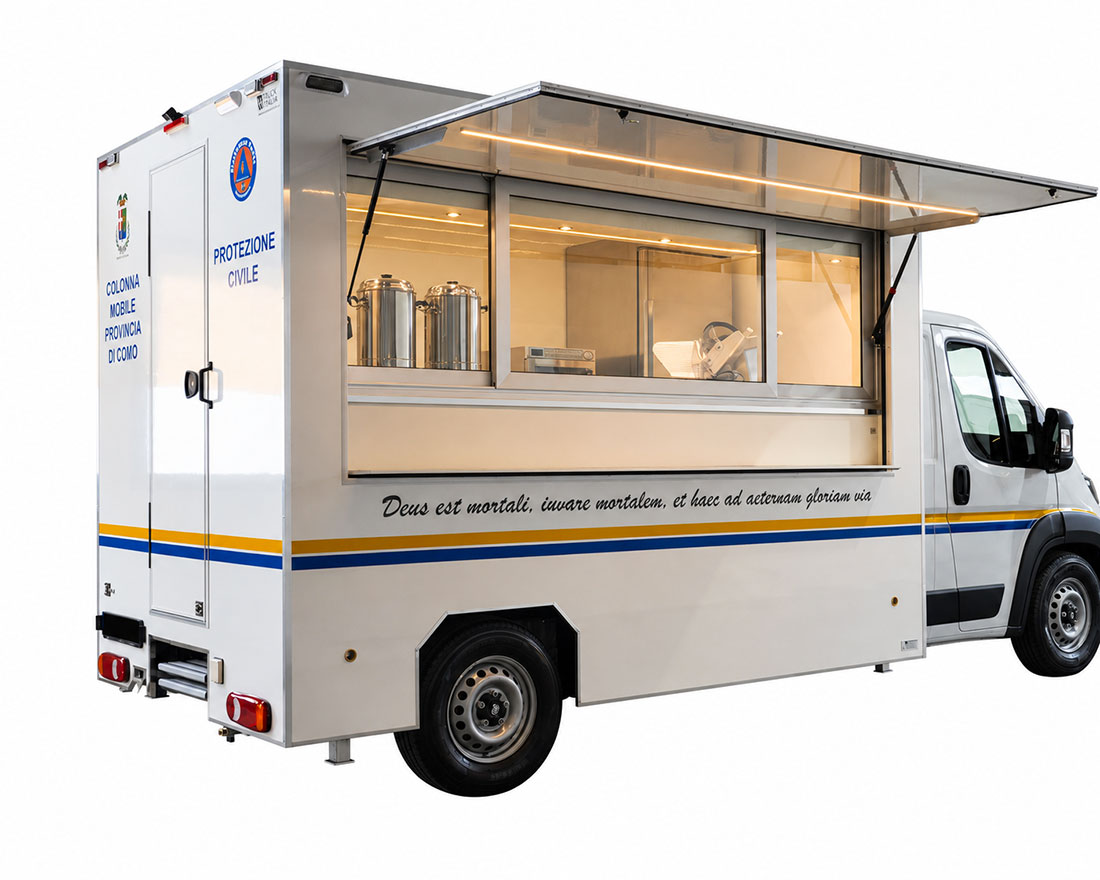
For the Civil Protection service in the province of Como, we built a food truck equipped to support emergency response and relief operations, using a Fiat Ducato as the base vehicle.
The vehicle provides a professional working environment, with a coffee machine, electric water boilers, a microwave oven, an electric slicer and an upright refrigerator-freezer unit. Stainless steel worktops and a large side serving counter allow staff to organise food preparation and distribution efficiently.
The conversion also includes equipment selected for the conditions in which the vehicle will operate: exterior LED floodlights to illuminate the surrounding area, air conditioning, emergency warning devices and an electrical system that can draw power either from the mains or from an integrated generator.
This project allowed us to adapt the features of a professional food truck to the needs of an organisation providing essential public services, with particular attention to equipment reliability and ease of use in different operating conditions.
Grimaud Tourist Office: a mobile Information Point for visitors
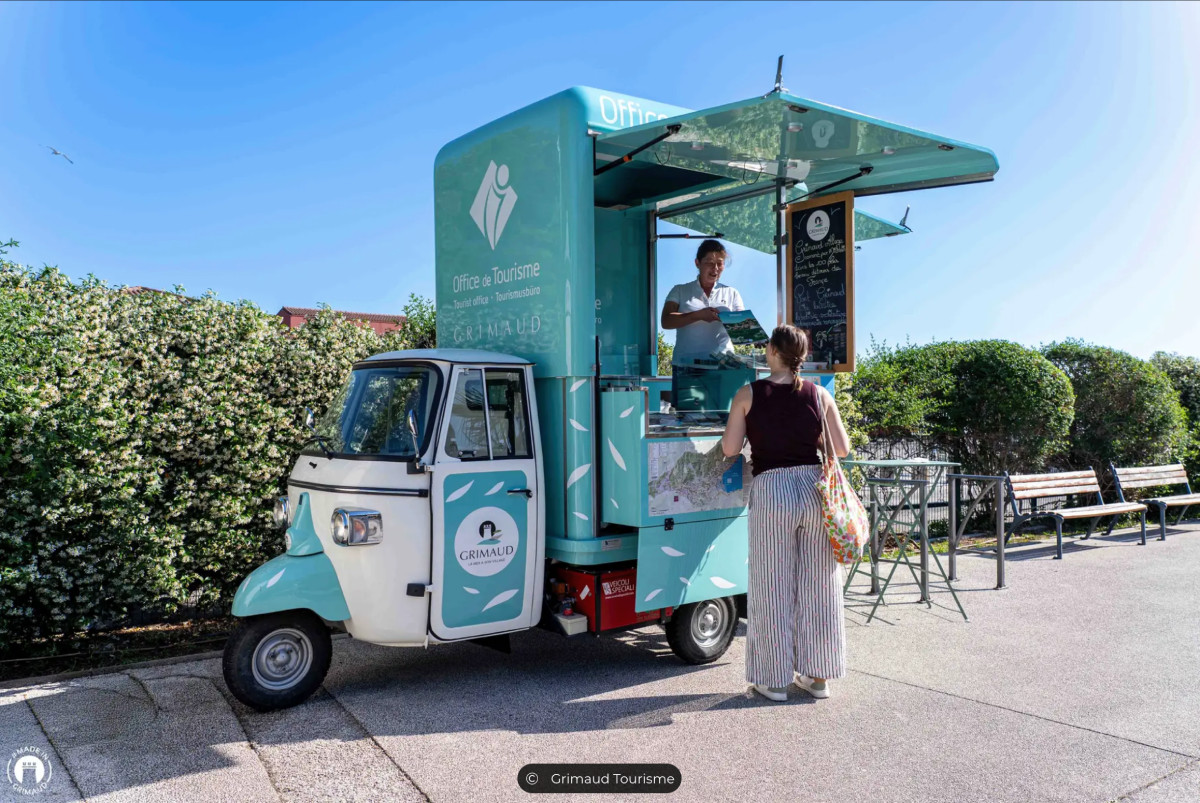
In Grimaud, in the south of France, the local tourist office chose an original way to establish a presence in the places most frequently visited by tourists: a Piaggio Ape converted into a promotional vehicle and mobile tourist information point.

The concept is particularly well suited to a tourist destination. Rather than expecting visitors to find their way to a conventional office, the service can move to wherever it is most useful, supporting events, local initiatives and periods of increased visitor activity.
To bring the idea to life, we developed a compact vehicle conversion incorporating a reception counter, dedicated storage for tourist information materials and carefully designed custom graphics that make the vehicle easy to recognise.
Within just a few square metres, the unit provides everything needed to welcome visitors, offer guidance and distribute brochures and other information. Its appearance also helps create a friendly, approachable point of contact that fits naturally into the atmosphere of the destination.
The Grimaud project offers an interesting example of how mobile offices and information points can extend the reach of public services.
Food Machine: a snow groomer converted into a mobile kitchen
One of the most unusual projects we have undertaken took us to the ski slopes of Bardonecchia, in the Melezet ski area.
The vehicle at the centre of the project is Food Machine, a snow groomer converted into a mobile catering unit capable of bringing food service to an environment that ordinary road vehicles cannot reach.
The idea was to make use of the tracked vehicle‘s ability to travel across snow, allowing skiers to stop for something to eat directly on the slopes without having to return to the resort below.
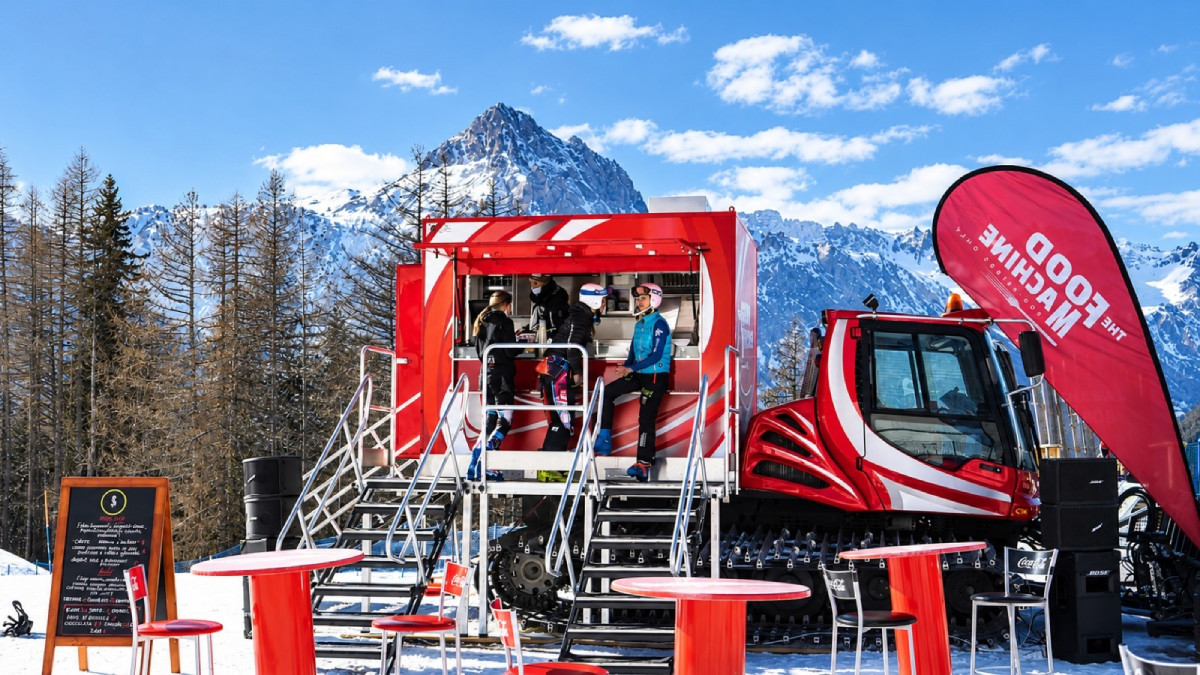
The conversion called for a completely different design approach from that of a conventional food truck. The snow groomer’s structure was adapted to accommodate an equipped food preparation and serving area, with a service opening and steps allowing skiers to reach the raised counter.
The exterior was also carefully designed to give the vehicle a distinctive and recognisable identity, reflecting the originality of the concept.
Food Machine is a project we are particularly proud of, as it captures one of the most rewarding challenges of our work: finding technical solutions for ideas that have no established model to follow. In this case, a vehicle originally designed for working on snow was given an entirely new purpose, becoming part of a unique high-altitude dining experience.
Equipped vans, trailers and container conversions: which solution to choose?
These three projects offer just a glimpse of what specialist vehicle conversions can achieve. There are many other possibilities, and a van or truck is not necessarily the best starting point for every project.
The choice depends on the service to be provided, but also on how the unit will be used and how frequently it will need to be moved. The main options offer different advantages:
- Equipped vans and converted commercial vehicles: suitable for mobile services requiring frequent travel, quick deployment and the flexibility to work in different locations.
- Trailers and towable units: a practical choice for temporary activities, events and operational workstations that need to be moved between locations using a suitable towing vehicle.
- Converted containers and modular units: particularly useful when larger working areas, heavy equipment, more extensive technical systems or installations intended to remain in one place for longer periods are required.
Mobile kitchen container: Around

A suitably equipped container, for example, can accommodate a professional kitchen, a laboratory, an office or a logistical support facility. Its interior layout and equipment can be customised to suit the intended activity, with provision for independent electrical and water systems where necessary.
For other applications, however, mobility is the main priority. A mobile workshop or a technical service vehicle must allow operators to reach a job quickly, find their tools properly organised and have the resources they need readily available.
We can also develop special-purpose vehicles and other custom-built units for particular professional applications, working with different platforms according to the operating conditions and equipment requirements. Each configuration must also be assessed in relation to the vehicle’s technical characteristics and the applicable type-approval requirements.
Nor is it always necessary to begin with a new vehicle. We can consider converting an existing one, provided an initial assessment confirms that its structure and technical characteristics are suitable for the intended use.
Layout, onboard systems and materials: what matters in a professional vehicle conversion
At VS Veicoli Speciali, we pay particular attention to the details that affect everyday working conditions, looking for practical solutions that make the vehicle easier to operate and maintain over time.
Practical layouts for comfortable working conditions
A mobile kitchen needs to provide a smooth workflow from food storage to preparation and serving. In a mobile workshop, tools and materials should be easy to reach without getting in the way, while a public information unit needs a reception counter that is comfortable for both staff and visitors.
These details may seem relatively minor when looking at a design on paper, but they become essential after many hours of work.
Restaurant container: Around

When planning the interior, we aim to make the best possible use of every available surface, finding the most practical position for equipment, storage compartments, access points and workstations. Side openings, canopies and any external working areas are also designed around the activities they will need to accommodate.
Reliable systems and operational self-sufficiency
For a vehicle intended for professional use, access to electricity, water and other essential resources can be crucial, particularly when working away from conventional infrastructure.
Depending on the project, the conversion may require independent electrical systems, generators, water tanks and plumbing, refrigeration, air conditioning, ventilation or professional lighting.
Integrating these systems involves careful consideration of the available space, energy consumption and the conditions in which the vehicle will operate. Equipment weight, load distribution, material durability and any relevant regulatory requirements must also be taken into account.
We want our conversions to be robust and practical to manage, with systems that remain accessible for maintenance and solutions designed to perform reliably over time.

Exterior customisation is another important consideration, particularly for vehicles used in public services or promotional activities. Colours, graphics, shapes and materials are selected to reflect the client’s identity and make the vehicle easily recognisable.
Experience and adaptability play an important role in this work. Projects such as those developed for Como Civil Protection, the Grimaud Tourist Office and Food Machine have given us the opportunity to apply established skills to new situations, developing a different solution each time.
And that is what continues to make our work so rewarding: collaborating with clients and bringing an idea to life, transforming it into a practical, reliable working tool.
Are you considering a fully equipped vehicle for your business, a public service or a particularly unusual project? Let’s discuss it. We will do our best to find an effective, technically sound solution that also makes financial sense.


